

As leaders, you’re always searching for ways to work more efficiently, provide improved services to the community, and engage your constituents more productively. AI chatbots like ChatGPT, Claude, and Gemini certainly seem like they could be the answer. They can compose documents at the click of a button, and they can provide fresh insights when you’re feeling stuck.
At present, far too many highly intelligent government executives and agency heads are committing a serious error that could ruin their professional lives, generate enormous legal liabilities, and expose the deepest recesses of their minds during a court proceeding. The bottom line: AI chatbots are not your friends. They will reveal your secrets to the world.
Think about this: You are at your office grappling with a difficult matter, or you are prepping for an intense meeting. You want to talk to someone, someone who you know has your best interests at heart, who is always there, who is super patient and nonjudgmental, and who will never tell. A chatbot is ideal. The thing is, chatbots may sound like friends, but they are not. Legally speaking, they are simply another third party. That detail is trivial for you, a non-lawyer, but it is very significant when you go to court.
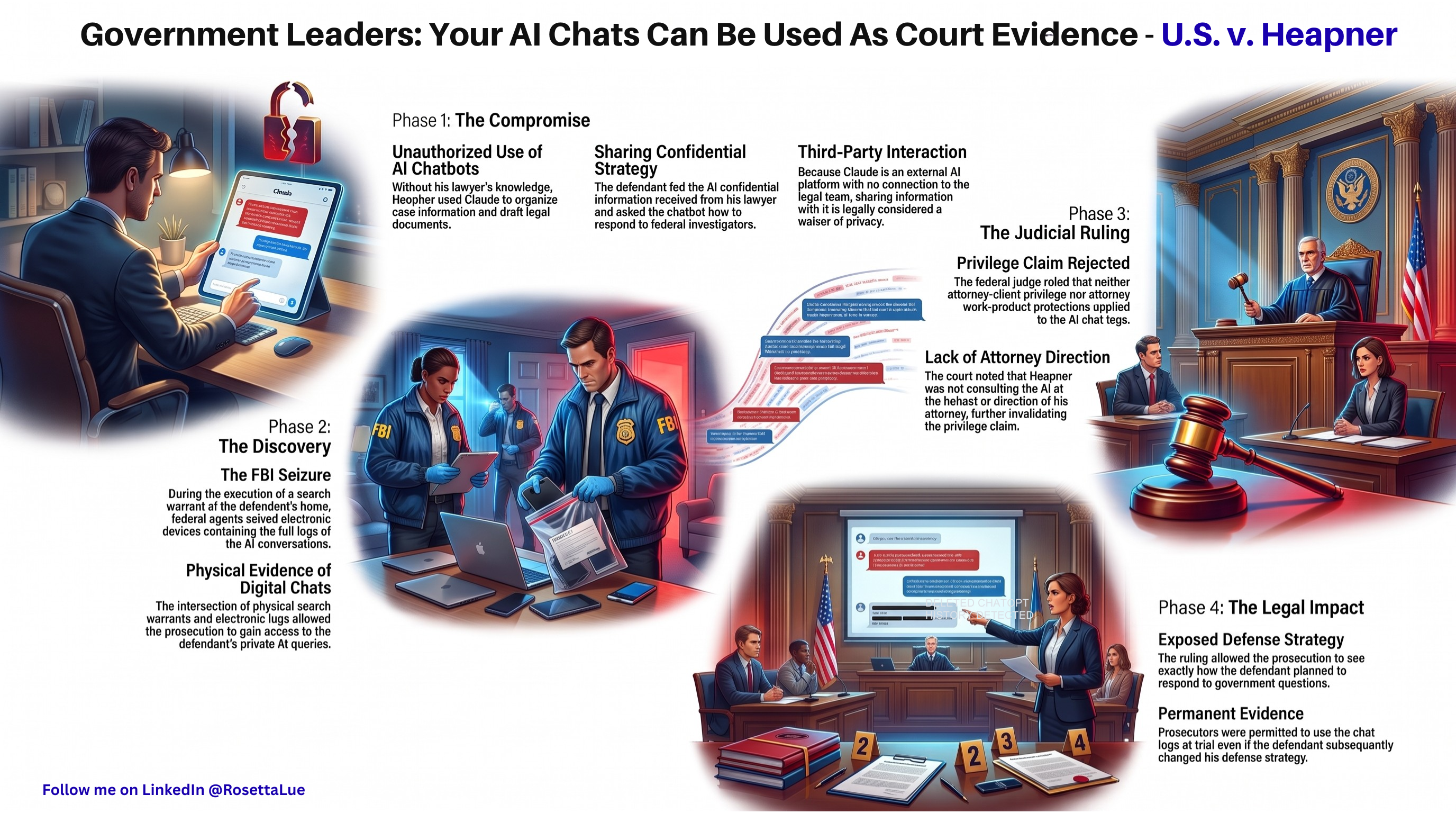
Let’s look at a recent federal case. Every governmental official and public officer should pay close attention to U.S. v. Heapner. Heapner was the subject of a massive federal criminal investigation, so he decided to gather his thoughts before speaking with his attorneys. While speaking to his lawyer, he fed the chatbot information that was shared in confidence. The chatbot responded. The chatbot suggested answers for him to use when confronted with investigators. Heapner believed all of this was confidential and private.
Then, federal agents searched his home and seized his personal electronics. And what did they find? All of his conversations with Claude. They now had access to all of his legal thoughts. In addition, the federal prosecutors were thrilled by this discovery, and they want to use all of the AI chat history at trial. Heapner attorneys strongly objected to that idea. They claimed that the documents should be covered by the privilege of the attorney-client, the rule that keeps the relationship between you and your counsel a secret.
However, the federal judge reviewed the evidence and decided against applying the privilege. The reasoning was straightforward: AI constitutes a third party. Heapner was not speaking to his attorney; he was speaking to Claude, an artificial intelligence platform. If you voluntarily convey confidential information to a third party who is not involved in your legal defense, it constitutes a waiver of your confidentiality rights. Furthermore, Heapner did not seek the counsel of his attorney to create these documents or consult with the AI on their account. The ruling spelled doom for Heapner’s case. They essentially served a complete briefing of his defense to the prosecutors. They would have been free to reference those past conversations as evidence, even if he opted to change his defense.
As government executives, you are held to a much higher standard of transparency. When public officials are involved in a lawsuit, the opposing counsel may legally request access to your correspondence as part of the “discovery” process, and yes, the lawyers can subpoena your interaction with chatbots and other AI just as they would your official emails and phone records. That is because it is where private citizens often disclose their genuine thoughts without filters.
Technology advances with each passing day, but consequences are forever. The next prompt you enter may well be entered as evidence and presented to a court. Before you enter your next prompt into AI, pause for a moment and ask yourself one question: “Would I mind having you, the public, the press, or a judge read this tomorrow?” If the answer is “no,” STOP. Shut the window and call the legal counsel for your agency. You can be safe, and you can be innovative. You can use AI and protect your organization. It’s not an either/or choice, but it starts with understanding where the limits lie.
How are you managing your AI governance for your employees around this risk?
⚠️ This piece is for informational and educational purposes and does not constitute legal advice and should not be relied upon as such. Laws and regulations concerning AI, privacy, and legal privilege vary according to jurisdiction and are in the process of being updated. If you have questions or concerns about anything specifically, particularly if it involves an inquiry or the confidentiality of records, contact your legal counsel directly.

