In Fortis Advisors LLC v. Krafton, Inc. (Del. Ch. 2026), the Delaware Chancery Court ruled that a transcript of the gaming publisher's CEO using ChatGPT to avoid paying $250 million earnout to the developers of Subnautica 2 is evidence of bad faith. ChatGPT advised Krafton first that the earnout was noncancelable. After more prompts, it advised on a plan for Krafton to implement, which Krafton did. The court considered the AI transcripts as part of its bad faith analysis, and, in effect, the court ruled against Krafton in a way that Krafton tried to engineer with the chat bot to avoid. The case, in a way, is not about bad legal advice from AI. The issue is what happens when bad decisions based on AI output end up in court.
Use Case: The Hidden Dangers of AI Chatbots for Government Leaders – U.S. v. Heapner
In a recent federal court case, a man named Heapner was under a big government investigation. He wanted to get his thoughts organized for his lawyer. Without telling his attorney, he typed his secret legal strategies and confidential details into an AI chatbot named Claude. Later, the FBI searched his house and took his devices. The government prosecutors found his AI chat logs and wanted to use them as evidence in court. Heapner’s lawyers tried to stop them. They argued that these chats should be protected by "attorney-client privilege"—the rule that keeps your talks with your lawyer a secret. But the judge said no. The judge ruled that because Heapner was talking to an AI platform and not a real lawyer, the secret was broken. AI is considered a "third party." Once you share a secret with a third party, you lose your right to keep it private. The prosecution got to see his entire strategy.
Your Agentic AI (Digital Front Door) Is Only as Smart as Your Knowledge Base
If you can’t answer these questions, you are likely already in trouble. The most successful government AI initiatives are not fueled by the best technology but by the best information. When a citizen is routed to the wrong department, he or she is not going to say, “Oh, the problem is that the knowledge base wasn’t kept up to date.” They are going to say, “Oh, the problem is the government.” That is why knowledge management has to be a priority for leadership, not an add-on. The fastest way to a resolution is getting that person to the right place the first time.
Why Government Executives Must Treat AI Prompts Like Press Releases
Assume everything typed into a public AI chatbot can be seen or utilized by outside entities. Government executives must treat prompts like public statements rather than private, secure conversations.
Why Agentic AI Fails Without Comprehensive Documented Knowledge or Information—Delayed Responses Lead to High Call Volume
Your AI chatbot is not the problem. Your knowledge management is. I have watched government agencies invest thousands of dollars in AI tools — only to watch those tools stall, escalate, and frustrate the very residents they were supposed to help. Not because the technology was bad. Because the information behind it was buried, outdated, and scattered across shared drives nobody updates. Here is what Gartner found: 100% of AI virtual assistant projects built without solid knowledge management will fail to meet their goals. Not some. Not most. All of them. And a 2025 survey of more than 300 AI practitioners found that 61% say wrong or inconsistent answers are their biggest concern with AI adoption right now. That is the real problem hiding behind your call volume numbers.
7 Government Knowledge Management Pain Points: Why Agentic AI Fails Without Comprehensive Documented Knowledge or Information – Tip #1
Your AI chatbot isn't failing because of the technology. It's failing because it doesn't know enough. When government AI lacks access to complete, accurate, and documented knowledge, residents receive partial answers, outdated guidance, and confusing next steps. Trust declines. Complaints increase. Call volumes rise. Before investing in more AI tools, government leaders should ask a simple question: Does our knowledge exist in a system—or only in the heads of our employees? Agentic AI can only deliver great customer experiences when it is powered by comprehensive, current, and trusted knowledge. This is the first and perhaps most important AI readiness challenge facing government contact centers and 311 operations today.
Traditional Internet Search is Dying! Is Your City’s 311 Data Crawlable for Residents?
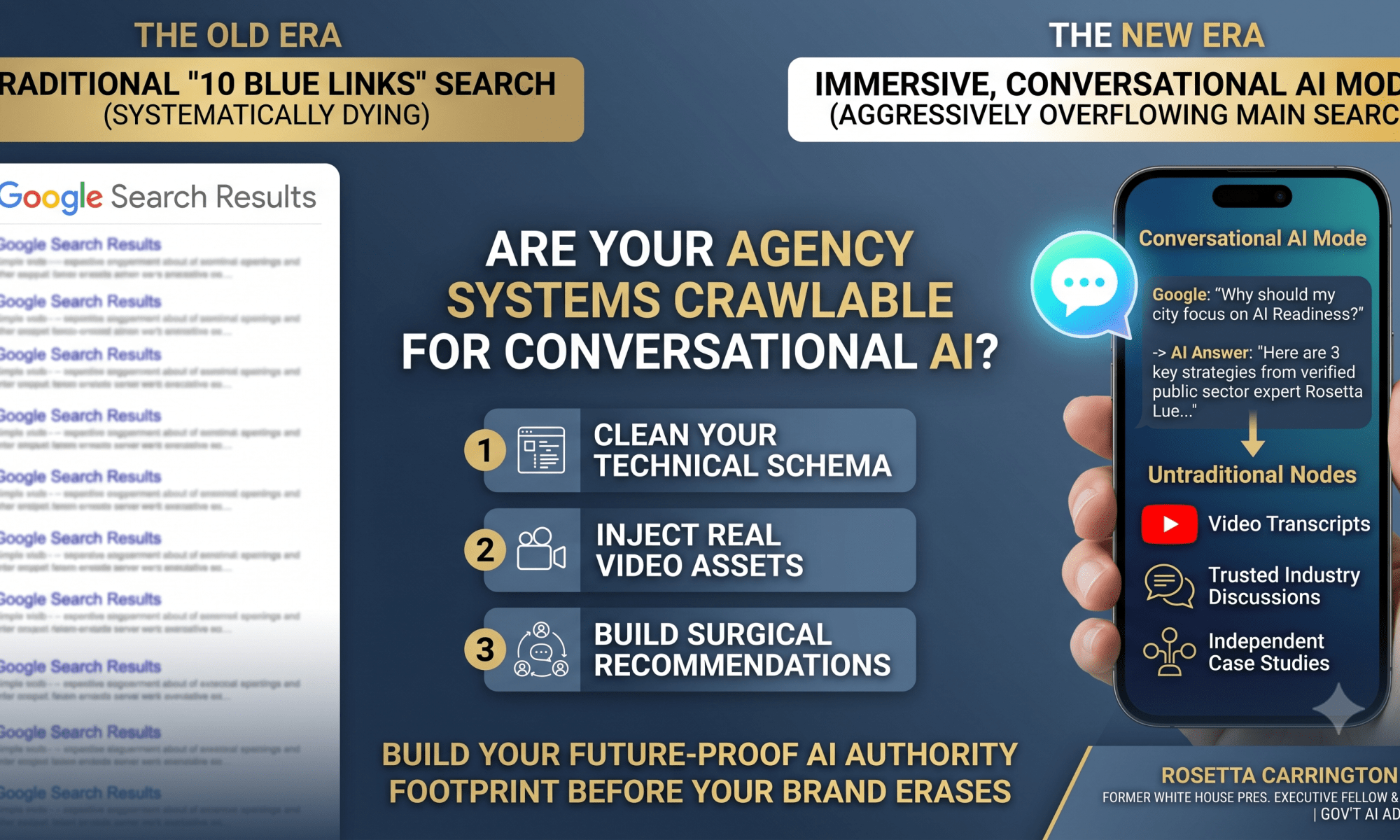
Google just confirmed what I have been telling government leaders for months. The era of the "10 blue links" is over. AI Mode has surpassed 1 billion monthly users. AI Overviews now reach more than 2.5 billion people a month. And the way your residents, business owners, and technology partners find government information online has fundamentally changed. If your agency's digital presence is buried behind an outdated web portal or missing from the spaces where your community actually searches — AI will not find you. And if AI cannot find you, neither can the people you serve. I am sharing three things government leaders can do right now to stay visible in the age of AI search.
Improving Government Contact Centers for Residents
Residents aren't comparing you to the agency down the street anymore. They're comparing you to Amazon. To their bank. To the app they used before they got out of bed this morning. The gap between what people expect and what most government contact centers deliver is real, and it's growing. The good news? You don't need a massive budget or a full IT overhaul to start closing it. Here are four things forward-thinking contact center directors are doing right now to build a better resident experience and a stronger agency brand, including why your AI readiness plan needs to come before your AI purchase.
The UAE Just Hired an AI Employee. Is Anyone Noticing?
What if your government agency had an employee who never slept, never called in sick, and could handle thousands of resident questions at the same time? That's not a fantasy. That's exactly what the UAE just built. Meet Rashid — the UAE Ministry of Economy and Tourism's first AI virtual employee. He's part of a growing digital workforce that includes DEWA's "Rammas," who has already answered over 12 million customer inquiries. And this is just the beginning. On April 23, 2026, the UAE announced a plan to deploy Agentic AI across 50% of its federal government operations within two years — backed by a commitment to train 80,000 government employees to work alongside it. The global AI virtual assistant market is on track to hit $124.9 billion by 2034. The technology is here. The strategy is real. The only question left is whether U.S. government leaders are ready to lead.
AI Case Study: Revolutionizing Permit Process Review Success
AI is changing what is possible in permit review. Across state and local government, planning teams are dealing with staffing shortages, long backlogs, changing codes, and growing pressure to move faster. Traditional permit review processes are no longer keeping pace with community needs. This case study shows how AI-assisted permit review can help agencies reduce review times, support overworked staff, and improve service without lowering standards. The goal is not to replace planners. The goal is to give them better tools so they can focus on complex decisions, community development, and faster outcomes for residents, builders, and local economies.