

When Agentic AI (Digital Front Door) directs the wrong residents, no one benefits
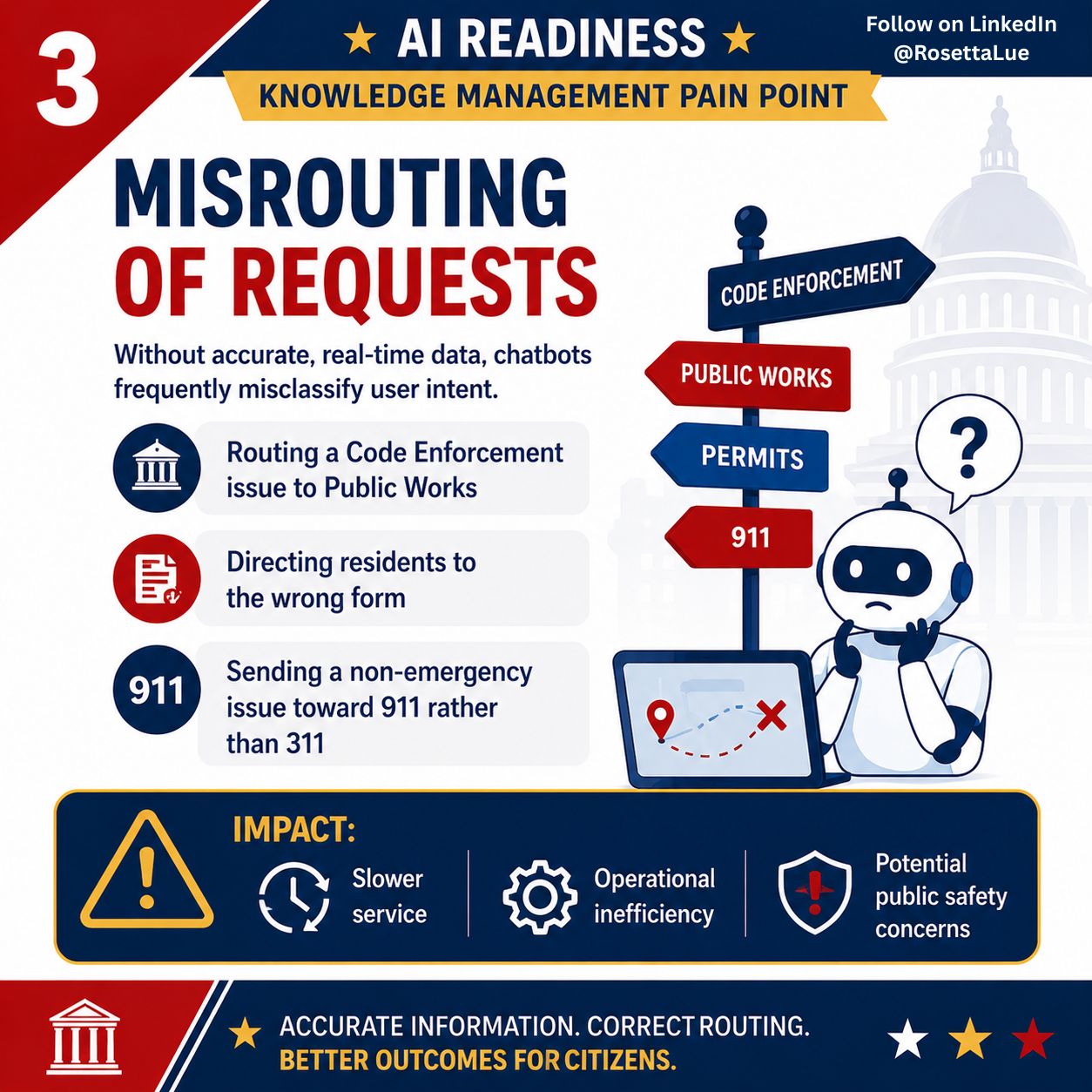
Knowledge Management Pain Point #3: Misrouting of Requests
Residents don’t start their day considering which agency is accountable.
They just want that pothole patched. They want that abandoned car to be taken. They want that illegal dumping to stop.
That sounds simple. But after two decades of leading government contact centers and 311 operations, I can tell you that getting residents to the right department is actually one of the hardest things for government to do. And as governments move to add AI into that mix, we may get worse before we get better.
Government is racing to adopt AI. The U.S. government increased its AI use cases by more than a factor of two in just one year, from 1,757 in 2024 to more than 3,600 in 2025. That excitement is understandable.
But Gartner says 63% of organizations either don’t have, or aren’t confident about having, the data practices required for AI. Moreover, they predict that 60% of AI initiatives won’t succeed because they aren’t supported by AI-ready data by the year 2026.
60% not because the tech failed. It’s because the knowledge behind it wasn’t ready.
The Wrong Agency Issue
A citizen arrives at your city’s website and asks the AI: “Who do I call about an abandoned property in my community?”
But, if the AI is incapable of accessing accurate definitions of the service, or if it’s not aware of the decision tree, or if the AI doesn’t know the current state of department ownership, the result is a guess. It may refer the resident to Public Works, when in fact they were really supposed to speak to the Code Enforcement team. It could send them to the wrong form. It might generate a service request with the wrong system. Or worse, it could send the resident into an eternal transfer loop, with no clear resolution in sight.
That resident has to call back. The supervisor then has to get involved. Three or four more staff members may have to work on the issue. A job that should have required five minutes is now taking five days.
Do that thousands of times a month, and the cost of misrouting can be very high.
In fact, IBM has discovered that more than a quarter of organizations experience cost of more than $5 million per year because of poor data quality. And when you aren’t a private enterprise, you can lose more than just revenue.
You lose the thing that’s even harder to earn back: The trust of your constituents.
AI isn’t Magic. It’s a Mirror
The most prevalent myth that I encounter is from government leaders who think that AI already “knows” how they do things.
It does not. AI is making a decision based solely on the data available to it at any given moment. If you have a service catalog that is incomplete, the workflow that you have inherited and is outdated, or if department ownership has changed and no one updated the knowledge base, then there is no real way for an AI to route anything. It is just as if we took a new employee on day one, provided them a phone, and then asked: “Can you direct this caller to the right agent?”
We are essentially doing that when we launch AI with knowledge that hasn’t been fixed yet.
According to Gartner, 85% of AI projects are not successful. A Deloitte research article found that 80% of AI initiatives face significant challenges due to poor data quality and governance. Additionally, the most comprehensive research on data readiness for AI in the world shows that while 60% of companies say AI is driving their data initiatives, only 12% say their data is actually ready for AI.
Misrouting is more than just annoying. In some cases, it is dangerous. Imagine a citizen reporting a problem, only for the request to go to the wrong department, resulting in longer response times and critical issues going unaddressed, eroding confidence in how the government protects citizens.
That is why we consider knowledge management to be more than just a customer experience issue. It is also a risk management issue.
If you want your next chatbot purchase or next AI pilot to be successful, you need to ask yourself a few questions before you even get started: Do I have a documented service catalog? Are departmental responsibilities well defined? Are routing rules documented and standardized? Is there a written and up-to-date escalation process? Does my knowledge base match current reality, and who is responsible for updating it?
Rosetta Carrington Lue is the Founder and President of GovCXP Digital Partners and Co-Founder of the National 311 Executive Council.

