

Here’s my #1 of 10 Things Government Leaders Should Never Tell ChatGPT: AI Chatbots Can’t Keep Your Secrets as You Think
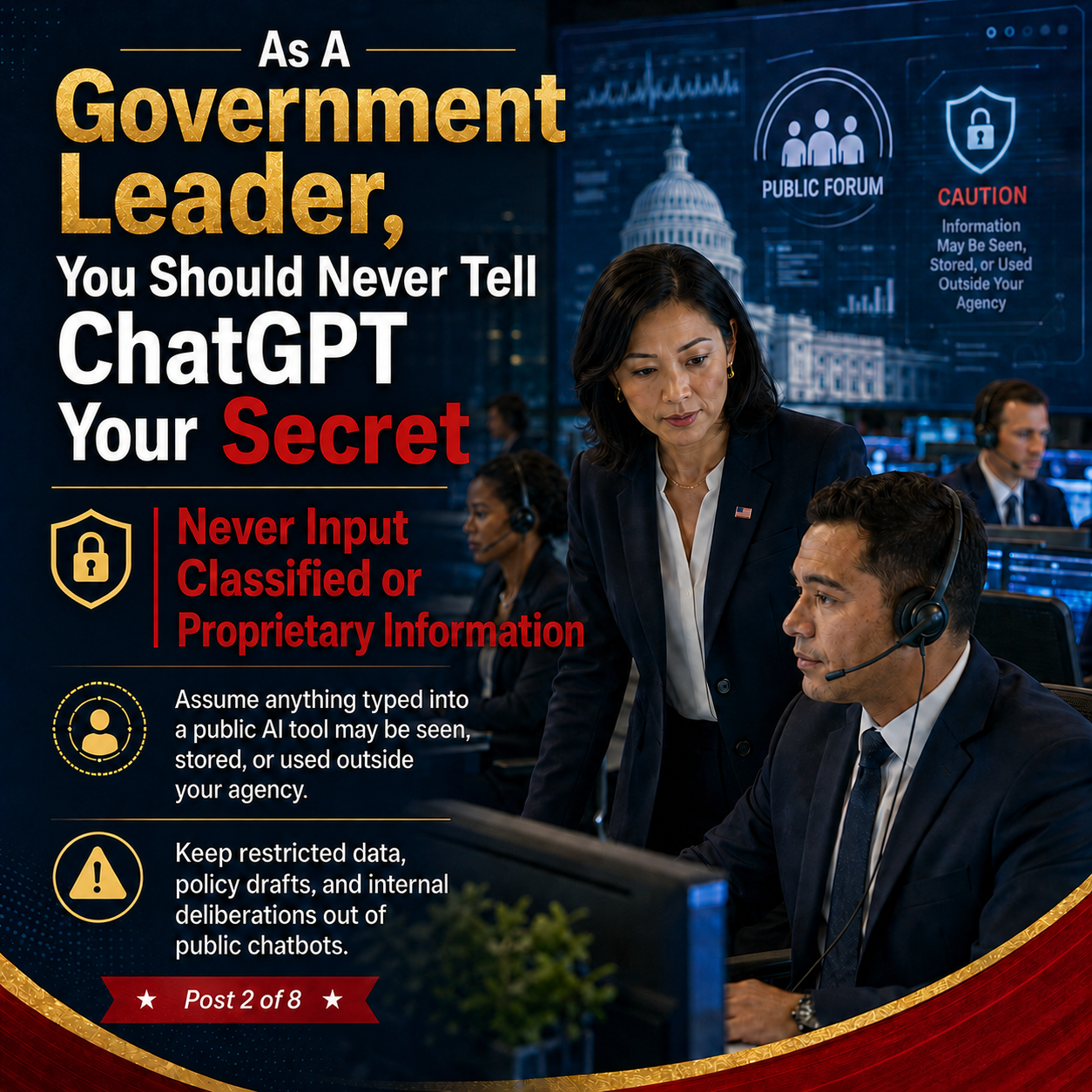
You wouldn’t walk up to a podium at a busy press conference and start talking to the audience about your agency’s unredacted strategic weaknesses, your draft deliberations on policy, or the interpersonal conflicts in your agency.
Yet, you do. You do that every day when you paste agency data, draft sensitive policy language, and more into an AI, and you think it’s safe.
But it’s not safe. You need to change your mindset: assume whatever you put in a public AI is public to others and can be accessed, inspected, or used by others. Government executives should treat their prompts to AI not as private, safe conversations, but as public statements.
It’s a digital illusion of privacy. When you enter a simple, clean chat box with an AI, it looks as secure as a blank page or even a child’s sandbox. It works so you don’t have to think about what happens in the box, and because it speaks so fast and so well, without any judgment.
But it is all an illusion. Unless your agency is using a government cloud instance of an AI that is set up for your exclusive use with specific carveouts, you are feeding information to commercial AI providers.
Most AI providers ingest everything that is in the public AI chat. If you provide a background to the AI, if you feed it information about the challenges your agency faces, or if you ask it to improve a draft, that is all going into the AI. Some even retain the conversations for as long as 90 days for human inspection or to catch abusive chat sessions, so a private contractor could see what you’re doing with the AI.
If you wouldn’t request a Freedom of Information Act (FOIA) of it, don’t prompt it
As a government leader, you live under the assumption that everything you write or say in the public service can be made public. If you write an email, it can be asked for by the public. You could be questioned about the communication.
That is true of what you write to the public AI as well. Don’t assume that an email is private. If you give an email to someone outside of your agency, you’re handing over a copy of your email.
If you ask a public AI to improve your draft regulation, improve your draft policy language, or tell you about someone you want to give a performance improvement plan, you’re handing over your data to an outside entity. The risk is you may hand over sensitive data, you may disclose information that you weren’t ready to disclose, and you may lose confidentiality.
This is a way of thinking differently, but it doesn’t mean you should fear the AI, it means that you should respect the AI. This helps you protect the public and protect your own agency.
So, how do you think differently about this? First, think about what you’re writing before you paste the information in, and scrub it. You don’t need to mention your agency name, the geographic locations that you’re talking about, or the names of people that you’re talking about to improve the information that you’re drafting. The AI doesn’t need that to do a task.
Second, set boundaries. Make sure everyone in the agency knows where they shouldn’t paste things, and that public AIs shouldn’t be used for any official government business unless it’s an AIs specifically designated for agency use.
Third, ask for the AIs that you should use. Your procurement office can set up AIs for your agency that comply with federal and state standards, with a specific opt-out on training your data.
The next time you’re typing something in, stop and ask yourself: if this information came out tomorrow, would I be okay with it being on the front page?
If you’re not okay with that, then don’t put it in. No AI can help you do that. keep public statements rather than private, secure conversations.
#AI #Leadership #Training #Government #AIGovernance #AIPolicy
 Building Welcoming, Connected, & Innovative Government Customer experience