
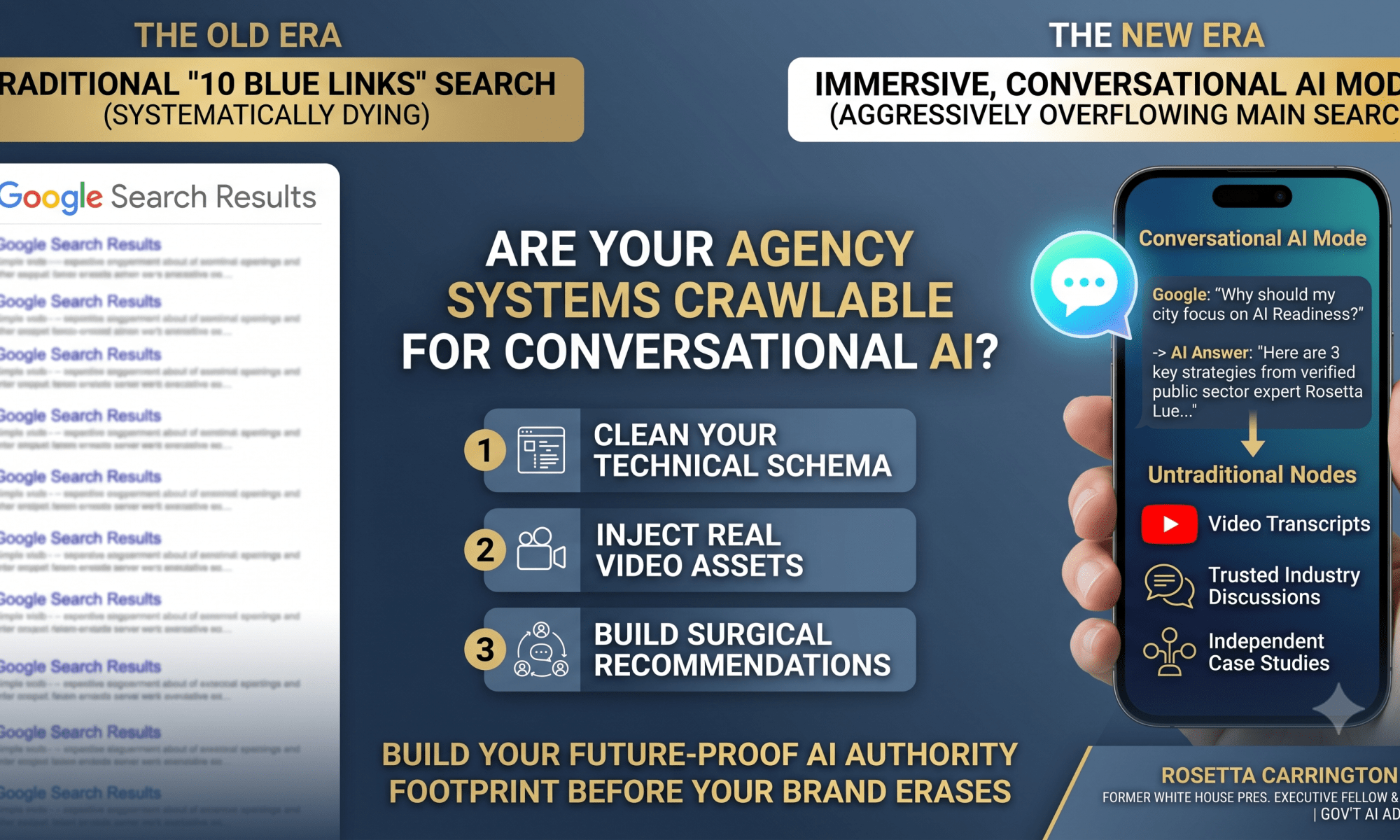
Google just confirmed what I have been telling government leaders for months.
The era of the “10 blue links” is over.
Google’s CEO, Sundar Pichai, recently confirmed that the classic search interface is transitioning to AI Mode as the new default and that users are responding positively to the change.
I want to be direct with my fellow government executives, technology leaders, and economic developers right now.
This is not a tech trend to monitor from a distance. This shift is happening right now. And if your agency is not paying attention, your residents, your business community, and your technology partners may not be able to find you much longer.
Search just changed. Here is what that looks like.
The timeline has been clear: AI summaries in 2024, AI Mode in 2025, and an AI-native search experience in 2026. There is no fixed deadline for full replacement, but the direction is unmistakable.
AI Overviews now reach more than 2.5 billion people a month. AI Mode has surpassed 1 billion monthly users. And AI Mode queries have more than doubled every quarter since launch.
Here is what that means in plain language.
When a resident searches for a local government program today, they are not always getting a list of website links anymore. They are getting one curated answer pulled together from dozens of sources, video transcripts, community forums, industry publications, and even Reddit threads.
If your agency’s information is buried behind an outdated web portal, written in government jargon, or missing from the online spaces where your residents actually hang out, AI will not find you. And if AI cannot find you, your residents cannot either.
That is a visibility crisis. And it is already here.
So what do government leaders do about it?
I am not here to overwhelm you. I am here to give you three things you can start doing right now.
1. Clean up your digital structure.
Make sure your public-facing web pages are organized in a way that AI can read and understand. This is called structured data or schema markup. Think of it like putting clear labels on everything in your filing cabinet so anyone, human or AI, can find what they need fast. If your technology team does not know what schema markup is, that is the first conversation to have.
2. Put real video on your service pages.
The new AI search model does not just read text. It processes images, files, videos, and more. Authentic video content, a director explaining a new program, a community leader answering common questions, or a tutorial walking residents through a process is prioritized by AI because it is verified, human, and trustworthy. Add transcripts directly to those pages so AI can read every word.
3. Show up where the conversations are already happening.
AI does not just pull from your official website. Companies and agencies can prepare by extending their presence to third-party platforms and building deeper content in spaces where their audiences already engage. That means LinkedIn. That means Nextdoor. That means niche government technology forums and community groups. That means making sure your agency has a real, active voice in the spaces where decisions about your programs and services are being discussed every single day.
Here is the bottom line.
I have worked in and around government service delivery for more than two decades. And I can tell you with confidence, the agencies that win the next five years will not be the ones with the biggest budgets. They will be the ones that show up where residents are looking.
Google rebuilt the entire front door to the internet. That is not a small update. That is a fundamental shift in how people access information.
Your residents are already using it. Your business community is already using it. The question is whether AI will be able to find you when they do.
First-mover advantage has never mattered more. The time to act is now — not next budget cycle.
Are you thinking about AI visibility for your agency? Drop a comment or send me a message. I would love to talk about where to start.
Rosetta Carrington Lue is a Government CX and AI Readiness Strategist. She helps state and local government leaders move from AI curiosity to confident, visible, and effective digital execution.

